

Choosing the right slant bed CNC lathe is an important decision for manufacturers producing shafts, bushings, sleeves, fittings, flanges, and other rotational components. The appropriate machine depends on workpiece dimensions, material, machining operations, dimensional tolerances, and production volume.
A slant bed CNC lathe uses an inclined bed structure to support turning operations. Depending on the machine design and configuration, it may also accommodate live tooling and additional machining axes for selected milling, drilling, and tapping operations.
GOLDCNC offers slant bed CNC lathes and CNC turning solutions for different production requirements. This guide explains the key selection factors, the differences between standard turning and turn-mill configurations, common industrial applications, and the factors that influence slant bed CNC lathe price.
1. What Are the Advantages of a Slant Bed CNC Lathe?
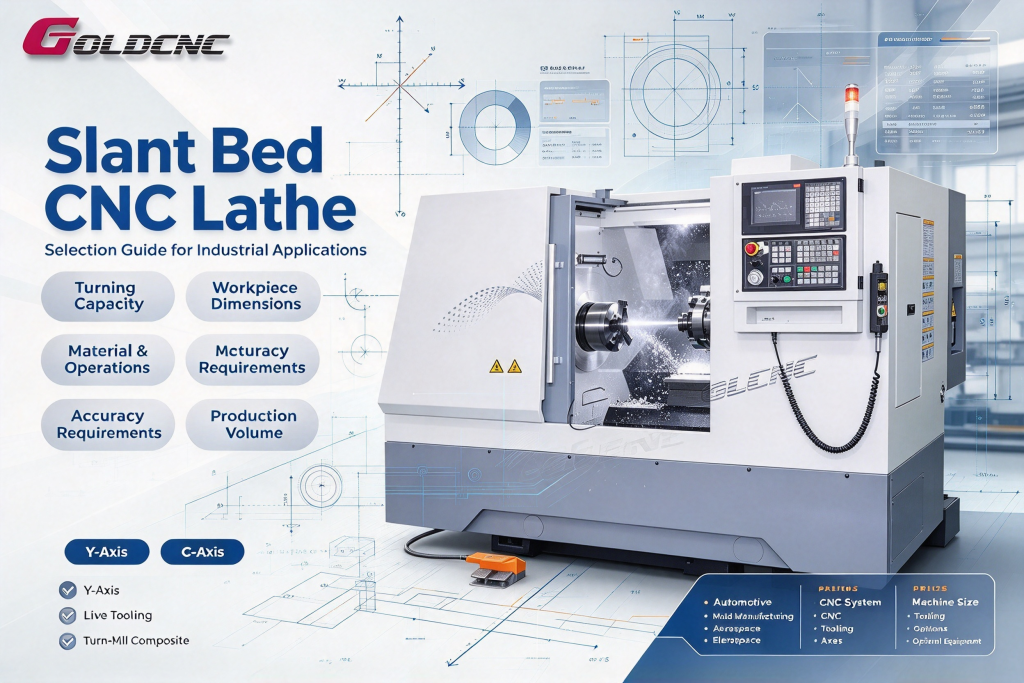
A slant bed CNC lathe features an inclined machine bed that supports the main machining components. The bed design can facilitate chip evacuation and provide access to the machining area, depending on the machine layout and enclosure.
When evaluating a slant bed CNC lathe machine, consider the following factors.
Turning Capacity and Workpiece Dimensions
Confirm the maximum machining diameter, recommended turning diameter, machining length, spindle bore, and bar capacity.
These specifications serve different purposes. Maximum swing diameter does not necessarily represent the maximum practical cutting diameter, and the usable machining length depends on the workholding arrangement and machine configuration.
For shaft and sleeve production, also consider whether the workpiece requires tailstock support, a sub-spindle, or additional clearance for tools and fixtures.
Spindle Specifications
Spindle speed, motor power, torque characteristics, spindle nose, chuck size, and spindle bore influence the range of turning operations the machine can support.
For example, smaller components may require higher spindle speeds, while larger steel parts may require a different balance of speed, torque, and cutting stability.
The appropriate spindle should be selected according to the material, workpiece dimensions, cutting tools, and intended machining process.
Turret and Tooling Configuration
The turret determines the available tool positions and affects how different machining operations can be arranged.
Before purchasing, confirm the turret type, number of stations, compatible tool dimensions, boring-bar capacity, and whether live tooling is required.
If the production process involves multiple turning tools, drills, or milling cutters, check that the proposed turret and tooling arrangement supports the intended sequence.
Y-Axis, C-Axis, and Live Tooling
A standard turning configuration may be sufficient for parts that primarily require external turning, facing, grooving, threading, and compatible boring operations.
A machine equipped with a C-axis and live tooling can support selected drilling and milling operations on the workpiece. A Y-axis may be required for features positioned away from the centerline, such as certain off-center holes, slots, and milled surfaces.
However, not every part requires a Y-axis. The decision should be based on the part drawing and the required machining sequence.
For compatible components, combining turning and secondary machining operations in one setup may reduce repeated workpiece handling. The actual benefit depends on part geometry, tooling, programming, and process planning.
2. GOLDCNC Slant Bed CNC Lathe Models
GOLDCNC lists DS Series and TC Series slant bed CNC lathes for different turning and machining requirements. The appropriate model should be selected according to the workpiece envelope, spindle specifications, tooling configuration, and required machining functions.
DS Series Slant Bed CNC Lathe
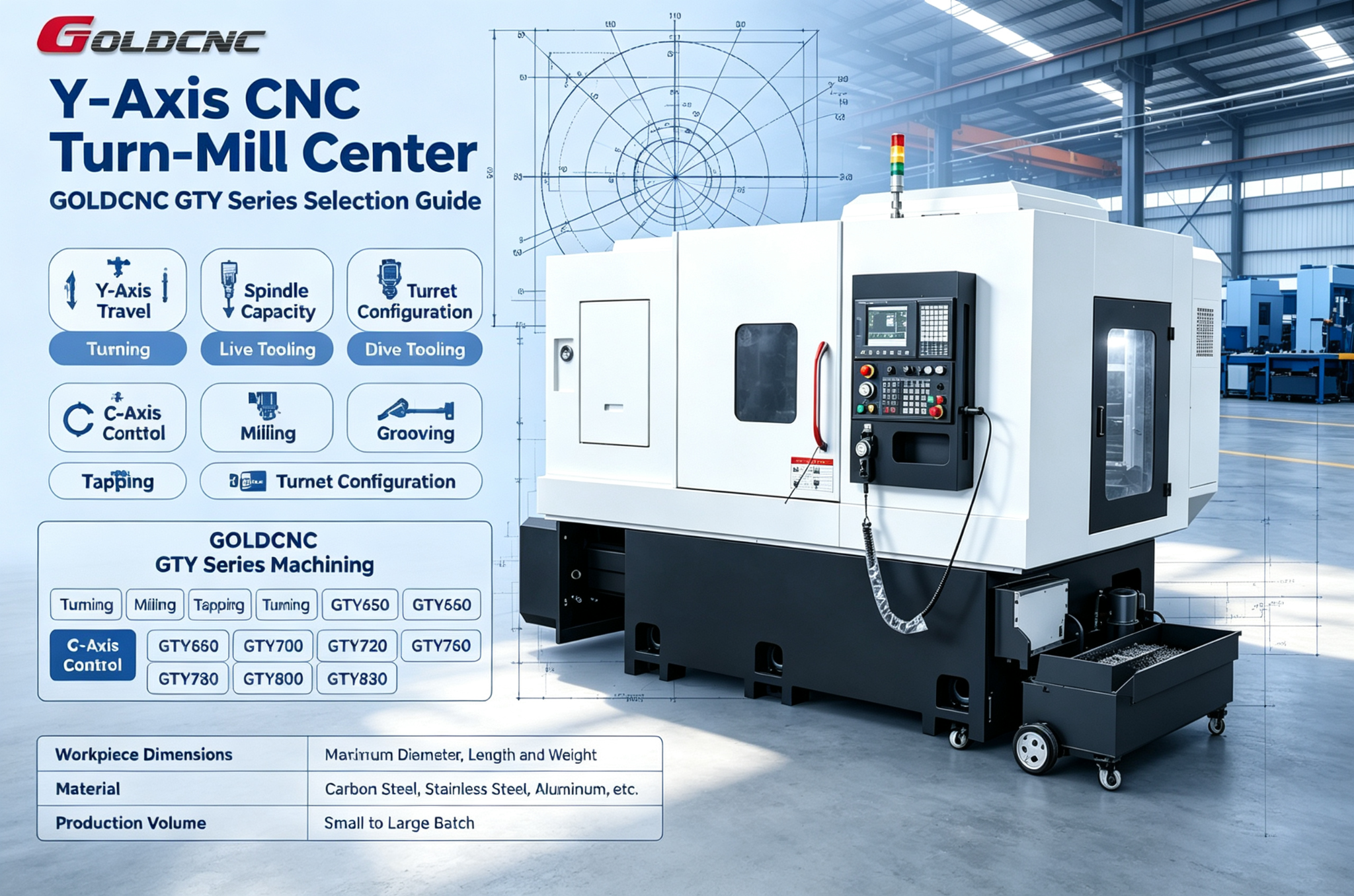
The GOLDCNC DS Series slant bed CNC lathe includes configurations designed for combined turning and secondary machining operations.
Published DS Series specifications identify DS-8 and DS-8L variants with different machining lengths. The listed configurations include C-axis control, live tooling, and Y-axis travel, subject to the specified configuration.
This series may be worth evaluating for rotational components that require turning together with compatible off-center milling, drilling, or tapping operations.
Before selecting a DS model, confirm the maximum machining diameter, effective machining length, spindle and sub-spindle specifications where applicable, turret arrangement, and the required axis configuration.
TC Series Slant Bed CNC Lathe
The GOLDCNC TC Series slant bed CNC lathe includes models with different turning capacities and workpiece requirements.
Published product information lists TC-580 and TC-800 configurations with different maximum turning diameters, spindle specifications, and machining envelopes. The available Y-axis configuration and turret arrangement should be confirmed for the specific model being considered.
This series may be suitable for evaluating turning applications involving shafts, sleeves, fittings, and other rotational components, depending on the required dimensions and machine configuration.
How to Compare DS and TC Series
Do not choose between DS and TC based on the series name alone. Compare the actual specifications and required machining functions.
| Selection factor | What to confirm |
|---|---|
| Workpiece size | Maximum machining diameter and length |
| Spindle | Chuck size, spindle bore, speed, and power |
| Tooling | Turret type, station count, and tool dimensions |
| Additional axes | C-axis and Y-axis availability for the selected model |
| Combined machining | Whether live tooling supports the required operations |
| Production needs | Batch size, cycle-time target, and workpiece handling |
| Optional equipment | Sub-spindle, chip conveyor, bar feeder, or automation where available |
Review the GOLDCNC CNC lathe machine range to compare the available machine categories and identify the appropriate model for your application.
3. Industrial Applications and Representative Machining Scenarios
A slant bed CNC lathe can be considered for a range of rotational component manufacturing tasks. The most suitable configuration depends on the component drawing, material, machining sequence, and production requirements.
The following examples illustrate typical industrial applications. They are representative scenarios rather than verified GOLDCNC customer case studies.
Automotive Component Manufacturing
Typical parts: Shafts, bushings, coupling components, sleeves, and selected transmission-related components.
Representative machining scenario: A manufacturer needs to turn the outside diameter and end faces of a shaft, followed by drilling or milling additional features where the machine configuration permits.
Key selection considerations:
- Material grade and workpiece dimensions.
- Required diameter tolerances and surface finish.
- Chucking method and workpiece support.
- Required production volume and cycle time.
- Whether live tooling or additional axes are needed.
For repeated production, evaluate the complete process, including loading, tool changes, machining sequence, and inspection requirements.
Mold and Tooling Component Manufacturing
Typical parts: Guide bushings, sleeves, cylindrical tooling components, and selected mold-related parts.
Representative machining scenario: A tooling workshop needs to turn a cylindrical component to size and machine grooves or end features according to the engineering drawing.
Key selection considerations:
- Workpiece material and hardness.
- Required surface finish and dimensional tolerances.
- Tool access and workholding stability.
- Grooving, threading, boring, or drilling requirements.
- Whether secondary milling operations are required.
The appropriate machine and tooling should be matched to the actual component geometry and manufacturing process.
Aerospace-Related Rotational Components
Typical parts: Suitable shafts, bushings, fittings, and other rotational components.
Representative machining scenario: A manufacturer needs to turn a component made from a specified material and machine additional features according to an engineering drawing.
Key selection considerations:
- Material machinability and cutting requirements.
- Specified dimensional tolerances.
- Workholding and tool accessibility.
- Inspection methods and documentation requirements.
- Any application-specific process qualification requirements.
Suitability must be evaluated for each component. A machine specification alone does not establish compliance with a particular aerospace application or customer standard.
Electronics and Industrial Equipment
Typical parts: Precision sleeves, connectors, equipment fittings, and selected cylindrical components.
Representative machining scenario: A supplier needs to turn small metal components to specified dimensions before secondary machining or assembly.
Key selection considerations:
- Part diameter and machining length.
- Dimensional consistency across batches.
- Tooling selection and tool-change requirements.
- Workholding and inspection methods.
- Whether drilling or milling features are required.
For smaller components, spindle speed, tooling compatibility, and the machining sequence should be evaluated together rather than considered separately.
General Machinery, Automation, and Robotics
Typical parts: Robot joints, drive shafts, spacers, bushings, flanges, and mechanical fittings.
Representative machining scenario: A manufacturer needs to turn a shaft and add compatible grooves, holes, or milled features.
Key selection considerations:
- Part geometry and required machining operations.
- Workholding and support for longer components.
- Tool access and turret configuration.
- Need for C-axis, Y-axis, or live tooling.
- Batch size and setup frequency.
If a component requires only conventional turning, a standard turning configuration may be sufficient. If it requires off-center milling or drilling, a suitable turn-mill configuration may be more appropriate.
4. What Affects Slant Bed CNC Lathe Price?
The slant bed CNC lathe price depends on the machine’s size, configuration, included equipment, and commercial terms. A meaningful quotation comparison requires equivalent technical specifications.
Machine Size and Turning Capacity
Maximum machining diameter, machining length, spindle bore, bar capacity, and workholding requirements influence the machine configuration.
A machine intended for larger workpieces may require a different spindle, chuck, bed structure, or support arrangement from a machine designed for smaller components.
CNC Controller and Control Functions
The CNC controller and its available functions affect programming, operation, and compatibility with the intended process.
When comparing quotations, confirm the controller brand and model, included software functions, supported machining axes, and any required options.
Turret, Live Tooling, and Additional Axes
A standard turret configuration and a live-tooling configuration do not provide the same machining functions.
C-axis control, Y-axis travel, driven tools, and additional spindle arrangements can change the scope of the supplied machine. Confirm which functions are standard and which are optional for the specific model.
Automation and Auxiliary Equipment
Depending on the application, a quotation may include or exclude equipment such as:
- Bar feeders or automatic loading systems.
- Chip conveyors.
- Parts catchers.
- Coolant systems and filtration options.
- Additional workholding equipment.
- Tooling and tool holders.
Evaluate these items against the actual production process rather than assuming they are included in the base machine price.
Shipping, Installation, and Service Terms
Commercial terms can affect the total purchasing budget. Confirm packaging, shipping terms, electrical requirements, installation arrangements, training, warranty scope, and spare-parts provisions.
Ask the supplier to identify any excluded costs and clarify which services are included in the quotation.
When comparing slant bed CNC lathe prices, evaluate the complete configuration and purchase scope, not only the initial quoted amount.
5. Common Purchasing Concerns and How to Address Them
Insufficient Machining Capacity
A machine may have a sufficient maximum swing diameter but an unsuitable effective machining diameter or length for the intended part.
What to do: Provide the largest workpiece dimensions and the proposed workholding method. Confirm the machining envelope, chuck size, spindle bore, and required tool clearance before ordering.
Long Machining Cycles
Cycle time depends on the machining sequence, cutting parameters, tool changes, workpiece handling, and the number of operations required.
What to do: Provide the part drawing, material, expected production volume, and target output. Ask the supplier to review whether the proposed tooling and machine configuration suit the intended process.
Unclear Need for a Y-Axis
A Y-axis may be unnecessary for parts that only require conventional turning or compatible on-center operations. Certain off-center milling and drilling operations may require Y-axis movement.
What to do: Identify the position and orientation of every required hole, slot, flat, and milled feature. Review the drawing before deciding whether a Y-axis and live tooling are needed.
Unexpected Configuration Costs
A quoted machine may not include every accessory, tool holder, or automation component required by the production line.
What to do: Request an itemized configuration list that distinguishes standard equipment, optional equipment, and excluded items. Ensure the final specifications are consistent with the purchase contract.
Unclear Accuracy Requirements
General machine specifications may not fully describe the results achievable for a specific component.
What to do: Identify critical dimensions, tolerances, surface-finish requirements, and inspection methods. Confirm the relevant machine specifications and acceptance criteria with the supplier.
6. How to Evaluate a Slant Bed CNC Lathe Manufacturer
When evaluating a slant bed CNC lathe manufacturer, consider technical documentation, configuration transparency, quality inspection procedures, and the scope of after-sales support.
Before making a purchasing decision, review the following points.
Technical documentation: Confirm the model-specific specifications, standard configuration, available options, and applicable inspection records.
Configuration transparency: Ensure that the controller, spindle, chuck, turret, live tooling, additional axes, and auxiliary equipment are clearly identified.
Application review: Provide workpiece drawings, material information, required tolerances, and the intended production process so the proposed configuration can be evaluated against actual requirements.
Service arrangements: Clarify the scope of technical support, operator documentation, installation guidance, warranty terms, and spare-parts arrangements for the specific order.
GOLDCNC manufactures CNC machine tools, including slant bed CNC lathes and CNC turning centers. Buyers can contact the team to review DS and TC Series options, discuss their machining requirements, and confirm the specifications relevant to their application.
Explore the GOLDCNC CNC lathe manufacturer and product range for company and product information.
Request a Slant Bed CNC Lathe Price Quotation
Looking for a slant bed CNC lathe for shafts, bushings, sleeves, fittings, or other rotational components?
To help evaluate a suitable configuration, provide the following information:
- Workpiece drawing and material grade.
- Maximum turning diameter and machining length.
- Required turning, drilling, milling, or tapping operations.
- Critical dimensions and tolerances.
- Expected batch size and production requirements.
- Preferred CNC controller and any required optional equipment.
GOLDCNC can review the available machine options and confirm the relevant technical specifications and quotation details for your application.
Contact GOLDCNC for a slant bed CNC lathe quotation to discuss your workpiece and production requirements.
