
Choosing the right band saw cutting machine is an important step in preparing metal stock for machining, fabrication, and assembly. The appropriate machine depends on the material, workpiece dimensions, required cutting length, cutting angle, production volume, and level of automation.
For manufacturers processing steel bars, pipes, tubes, and structural profiles, an unsuitable machine configuration can lead to inconsistent cutting lengths, premature blade wear, unnecessary manual handling, and production interruptions.
GOLDCNC provides metal band saw machines for different material preparation and production requirements. This guide explains how to evaluate cutting capacity, compare semi-automatic and fully automatic models, address common cutting problems, and identify the information needed before requesting a quotation.
1. What Is a Horizontal Band Saw Cutting Machine?
A horizontal band saw cutting machine uses a continuous toothed blade to cut metal stock to a specified length. Depending on the machine’s capacity and configuration, it can process suitable solid bars, pipes, tubes, and structural profiles.
In many manufacturing operations, band sawing is the first step before CNC turning, milling, drilling, welding, or assembly. The quality and consistency of this preparation stage can affect subsequent workholding, machining allowances, and production planning.
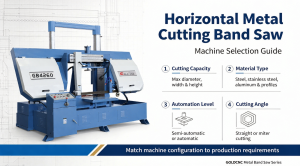
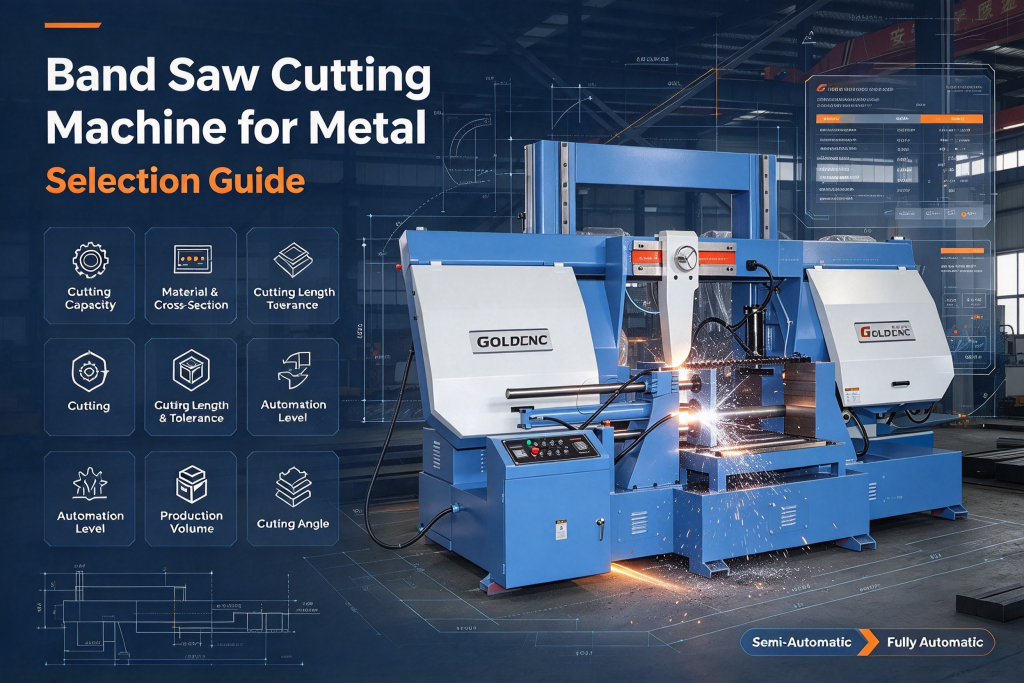
Before selecting a machine, evaluate the following factors:
- Cutting capacity: Confirm the maximum workpiece dimensions and cross-sectional shape within the required cutting angle.
- Material type: Identify the material grade, hardness, and whether the workpiece is solid or hollow.
- Cutting length and tolerance: Specify the required blank length and acceptable dimensional variation.
- Automation level: Determine whether semi-automatic operation or automatic measuring and feeding better suits the production process.
- Production volume: Consider the number of cuts per shift, batch size, and frequency of setup changes.
- Cutting angle: Confirm whether the process requires straight 90-degree cuts or angled cuts.
- Available utilities: Check the required voltage, frequency, phase, installation space, and operating conditions.
A machine should be selected according to the complete cutting requirement rather than maximum capacity alone.
2. Semi-Automatic vs. Fully Automatic Band Saw Machines
The appropriate automation level depends on how frequently material is cut, how often workpiece dimensions change, and how much operator involvement is practical for the production line.
Semi-Automatic Band Saw Machines
A semi-automatic band saw machine can suit general metalworking, maintenance, job shops, and production environments that process different materials or workpiece sizes. Operators remain involved in material loading, positioning, setup, and production supervision.
This configuration may be appropriate when flexibility and the ability to handle changing jobs are more important than automating every step of repetitive cutting.
Explore the GOLDCNC semi-automatic metal band saw machines to compare available models and cutting capacities.
Fully Automatic Band Saw Machines
An automatic band saw machine is worth considering when the same or similar materials need to be cut repeatedly in batches. Depending on the model, automatic functions may include measuring, feeding, sawing, and standby operation.
Automation can reduce repeated manual positioning and feeding tasks. However, the actual benefit depends on material handling, batch size, setup time, cutting parameters, and the operator’s responsibilities.
For recurring production, compare the required cutting length, feeding arrangement, automation functions, and material dimensions before selecting a model.
Explore the GOLDCNC fully automatic band saw machines for available configurations.
How to Choose Between the Two
Consider a semi-automatic machine when production involves frequent changes in material size, cutting requirements, or small batches.
Consider a fully automatic machine when repeated cutting operations, consistent feeding requirements, and batch production are central to the workflow.
The best choice is the configuration that matches the actual production process, not necessarily the machine with the highest automation level.
3. How to Select the Right Metal Band Saw Cutting Machine
Step 1: Confirm the Material and Cross-Section
Identify whether the workpiece is carbon steel, alloy steel, stainless steel, cast iron, aluminum, copper, or another material supported by the selected machine and blade.
Then specify its shape: round bar, square bar, rectangular section, pipe, tube, angle section, or H-section.
Material properties and cross-sectional geometry affect blade selection, tooth pitch, cutting speed, feed rate, and clamping requirements. Hollow sections may require different blade-tooth selection from solid bars of similar external dimensions.
Step 2: Calculate the Required Cutting Capacity
Measure the largest workpiece that needs to be cut, including its width, height, or diameter.
For angled cutting, check the capacity at the required angle rather than relying only on the machine’s straight-cut capacity. A machine that can accommodate a workpiece at 90 degrees may have a lower capacity when cutting at an angle.
For example, the GB4230X miter band saw machine is listed with a maximum straight-cut capacity of 300 × 300 mm. Its published capacity at 45 degrees is 240 × 240 mm. Confirm the applicable specification and workpiece shape before finalizing the selection.
Step 3: Match Automation to Production Volume
Estimate the number of cuts required per shift, the number of different workpiece sizes, and how often operators must change settings.
For repeated cutting, automatic feeding and measurement functions may help reduce repetitive handling. For mixed production, a simpler configuration may provide the flexibility required by the workshop.
When evaluating automation, consider the complete cycle, including loading, feeding, cutting, unloading, and material repositioning.
Step 4: Define the Required Cutting Accuracy
Specify the target cutting length, acceptable length variation, and any requirements for cut squareness or surface condition.
Actual results depend on material stability, blade condition, tooth selection, cutting parameters, clamping, machine setup, and measurement methods. Confirm the required tolerance with the supplier before purchasing.
Step 5: Evaluate the Complete Operating Process
Consider not only the machine purchase price but also blade consumption, operator time, material handling, coolant requirements, maintenance, and production downtime.
For batch production, compare the expected operating process under realistic conditions. A suitable machine configuration should meet the workpiece requirements while fitting the workshop’s production capacity and operating practices.
4. GOLDCNC Band Saw Models and Applications
GOLDCNC offers different metal band saw configurations for material preparation, general metalworking, and repetitive cutting operations. The following examples illustrate how to connect a model with a specific production requirement.
GB4230X: Semi-Automatic Miter Cutting
The GB4230X miter band saw is a semi-automatic option for applications that require straight cuts and angled cuts within its specified capacity.
It may be considered for cutting suitable bars, pipes, and structural sections before fabrication or machining. The operator remains involved in material positioning and loading.
Before selecting GB4230X, confirm the maximum workpiece dimensions, required cutting angle, material type, and production volume.
GZ4235X: Fully Automatic Miter Cutting
The GZ4235X automatic miter band saw is designed for repetitive cutting applications that require automatic operating functions and angled cutting.
Its published specifications list a maximum straight-cut capacity of 350 × 350 mm and a 45-degree capacity of 270 × 270 mm. The machine’s automatic functions and cutting-angle requirements should be checked against the current technical documentation.
This model may be worth evaluating for structural components, frame preparation, and batch cutting where repeated measuring, feeding, and cutting are part of the workflow.
Selecting a Model Based on the Application
Rather than choosing a machine by model number alone, compare the actual workpiece dimensions, required cutting angles, automation level, and expected cutting volume.
For additional options, review the GOLDCNC metal band saw machine range and compare the specifications of the relevant models.
5. Industrial Applications of Metal Band Saw Cutting Machines
Machinery Manufacturing and Mold Preparation
Steel bars and other metal stock are commonly cut into blanks before CNC turning, milling, drilling, or mold-related machining.
The cutting machine should accommodate the stock dimensions and material properties while producing blanks within the required length tolerance. Adequate material support and secure clamping are particularly important when handling long or heavy stock.
Steel Processing and Structural Fabrication
Metal band saw machines are used to prepare suitable bars, tubes, pipes, and structural profiles for welding, fabrication, and assembly.
For frames and structural components, the required cutting angle and cross-sectional dimensions should be confirmed before selecting a standard or miter-cutting configuration.
Automotive Component Production
Metal stock may be cut to length before turning, milling, drilling, and other component manufacturing operations.
Where production involves repeated blanks of the same dimensions, an automatic feeding configuration may help reduce repetitive positioning tasks. The appropriate setup depends on the component geometry, material, batch size, and downstream machining requirements.
Metalworking Job Shops
Job shops may process a wide variety of materials and workpiece sizes. In this environment, setup flexibility, accessible clamping arrangements, and suitable cutting capacity can be important selection criteria.
The machine should be matched to the shop’s most demanding regular workpieces while allowing for the variety of jobs it expects to handle.
6. Common Band Saw Cutting Problems and How to Address Them
Problem 1: Rough Cuts or Inconsistent Cutting Results
Possible contributing factors include an unsuitable blade tooth pitch, incorrect cutting parameters, worn blades, misaligned blade guides, insufficient workpiece support, or inadequate clamping.
What to check:
- Inspect the blade condition and confirm that its tooth pitch suits the material and cross-section.
- Check the blade guides and tension according to the machine manual.
- Review cutting speed, feed rate, and coolant application where applicable.
- Confirm that the workpiece is properly supported and securely clamped.
If the problem persists, record the material, workpiece dimensions, blade specification, and cutting parameters before adjusting the setup.
Problem 2: Premature Saw Blade Wear
Blade life depends on the material, workpiece geometry, blade specification, cutting parameters, and operating practices.
What to check:
- Select a blade suitable for the material and section size.
- Follow the recommended blade tensioning and running-in procedures.
- Confirm that cutting speed and feed rate are appropriate.
- Check coolant delivery and remove chips using the recommended method.
- Inspect the blade for damage and replace it when necessary.
Increasing blade tension or cutting speed without identifying the cause may not resolve the problem.
Problem 3: Workpiece Movement During Cutting
Movement during cutting can affect cut quality and length consistency. It may result from unsuitable clamping contact, incorrect positioning, inadequate support, or an unsuitable fixture for the workpiece shape.
What to check:
- Verify that the vise securely contacts the workpiece.
- Support long stock appropriately.
- Check the positioning of round, hollow, or irregular sections.
- Use suitable fixtures or jaw arrangements where required.
For hollow sections and bundled materials, confirm that the selected clamping arrangement is appropriate for the application.
Problem 4: Inconsistent Cutting Lengths
Length variation may be associated with feeding settings, the material stop, measurement references, workpiece movement, or changes in the material’s contact position.
What to check:
- Verify the feeding or length-setting procedure.
- Inspect the material stop and measuring reference.
- Confirm that the stock remains stable during feeding and cutting.
- Check the repeatability of the measuring and feeding system where fitted.
- Measure sample workpieces and compare the results with the specified tolerance.
If length consistency is critical, provide the target length and acceptable variation when discussing machine selection.
7. What Information Is Needed Before Requesting a Quotation?
To evaluate a suitable metal band saw cutting machine, prepare the following information:
- Material: Material grade and relevant hardness information, if available.
- Workpiece dimensions: Maximum width, height, diameter, wall thickness, or cross-sectional shape.
- Cutting requirements: Straight or angled cuts, required cutting length, and acceptable tolerance.
- Production volume: Expected cuts per shift, batch size, and operating hours.
- Automation preference: Semi-automatic operation or automatic measuring and feeding, where available.
- Blade and process requirements: Any specific requirements for cut quality, coolant, or downstream machining.
- Installation conditions: Local voltage, frequency, phase, and available floor space.
Providing these details helps the GOLDCNC sales team review the available machine options and confirm the relevant technical specifications.
Request a Band Saw Cutting Machine Quotation
Looking for a band saw cutting machine for metal bars, pipes, tubes, or structural profiles?
Share your material specifications, maximum workpiece dimensions, required cutting length, cutting angle, and estimated production volume with GOLDCNC.
Our team can review your application requirements, discuss available GB and GZ series options, and confirm the applicable machine specifications before you make a purchasing decision.
Contact GOLDCNC for a metal band saw quotation to discuss your cutting requirements.
