

A CNC machining center is an essential machine tool for manufacturers that require accurate, repeatable and efficient metal cutting operations. From automotive components and mechanical parts to precision molds and equipment housings, the right machine configuration helps manufacturers handle different machining requirements and production volumes.
When selecting a CNC machining center, buyers should consider more than the machine model. Workpiece dimensions, material, machining operations, spindle performance, tool capacity, positioning requirements and workholding arrangements all influence the final selection.
GOLDCNC provides vertical machining center solutions for a range of industrial metalworking applications. This guide explains the basic functions of a CNC machining center, introduces available VMC models, and outlines the main factors to consider before purchasing.
1. What Is a CNC Machining Center?
A CNC machining center is a computer-controlled machine tool designed to perform multiple cutting operations through programmed movements and automatic tool changes.
A vertical CNC machining center, commonly called a VMC, has a vertically oriented spindle. It is widely used for milling, drilling, boring, tapping and other machining operations on metal components.
Compared with conventional manual milling machines, a CNC machining center can execute programmed machining sequences with consistent tool paths and controlled cutting movements. A machine equipped with an automatic tool changer can also change tools according to the machining program, reducing the need for manual tool changes between operations.
Typical machining operations include:
- Face milling and profile milling
- Slotting and pocket machining
- Drilling and tapping
- Boring and reaming
- Contour machining
- Multi-face machining with suitable workholding, fixtures or additional axes
Depending on its configuration, a vertical machining center can support individual component manufacturing as well as batch production.
2. GOLDCNC VMC Models for Different Machining Requirements
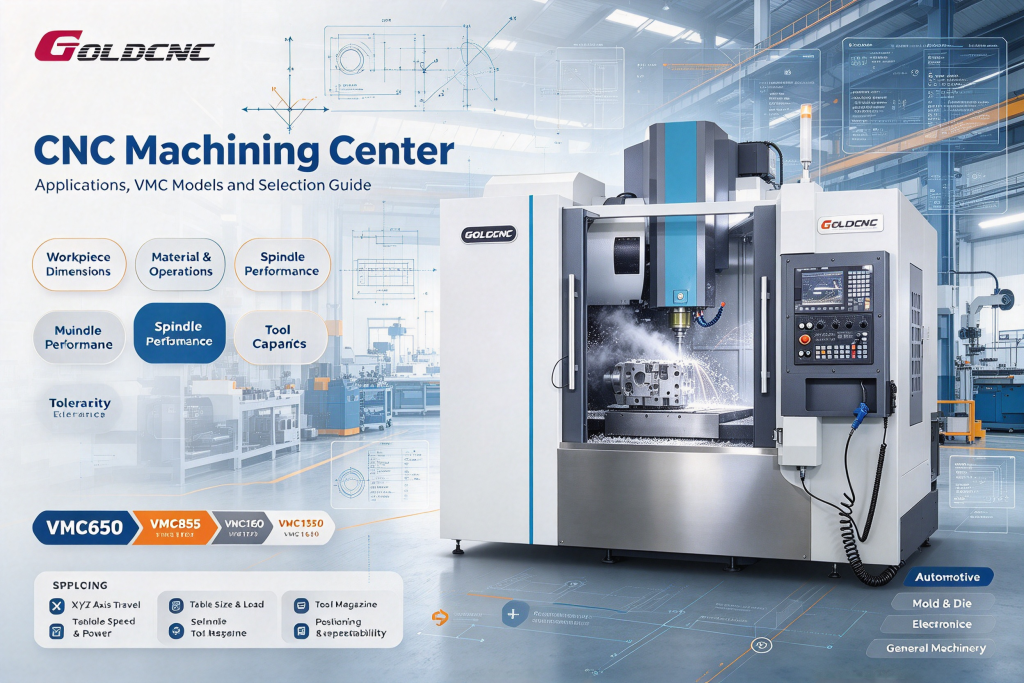
GOLDCNC offers a range of vertical machining center models designed for different workpiece dimensions and machining requirements.
The current product range includes models such as:
VMC650 / VMC850/ VMC1160 / VMC1270 / VMC1370
Different models provide different machining envelopes, table dimensions and spindle configurations. Buyers should compare the technical specifications of each machine with their actual workpiece requirements.
Key Specifications to Compare
X/Y/Z Axis Travel
Axis travel determines the available movement range of the machine. Buyers should check whether the workpiece, fixture and required tool approach can fit within the effective machining envelope.
Table Size and Loading Capacity
The worktable must accommodate the workpiece and its complete clamping arrangement. Workpiece weight and fixture dimensions should also be considered.
Spindle Speed and Power
Spindle specifications should match the material, cutting tools and machining strategy. Aluminum, carbon steel and alloy steel may require different cutting conditions.
Tool Magazine Capacity
Tool magazine capacity influences how many tools can be prepared for automatic tool changes. Consider the number of tools required by the complete machining process.
Positioning Accuracy and Repeatability
These specifications should be evaluated against the dimensional tolerances required by the finished components. Machine condition, workholding, thermal conditions and cutting processes also influence actual machining results.
CNC Control System
The control system should suit the operator’s programming experience, machining requirements and production workflow.
For buyers searching for a CNC machining center for sale, comparing the complete machine configuration is more useful than relying on model numbers alone.
Explore the GOLDCNC Vertical Machining Center Series to review available models and product specifications.
3. CNC Machining Center Applications Across Industries
Vertical machining centers are used in a variety of metalworking industries. The appropriate machine depends on component geometry, material, machining operations and production requirements.
3.1 Automotive Manufacturing
Automotive manufacturers and component suppliers machine engine parts, brackets, housings, transmission components and other metal parts.
A vertical machining center can perform milling, drilling, tapping and pocket machining according to the part design.
Typical machining scenario: Machining mounting faces, bolt holes and positioning slots on an aluminum or steel automotive bracket. Appropriate workholding and tool selection help maintain consistent machining results across production batches.
Selection considerations: Workpiece dimensions, material, machining tolerances, fixture design and production volume.
3.2 Mold and Die Manufacturing
Mold manufacturing often involves complex cavities, contours, pockets and precision mounting features.
A CNC machining center can be used for roughing and finishing operations on mold bases, inserts and other mold components.
Typical machining scenario: Milling a mold insert with stepped surfaces, pockets and mounting holes. The required machine travel, spindle capability, tool length and workpiece clamping should be evaluated before selecting a model.
Selection considerations: Machining envelope, spindle performance, tool access, surface finish requirements and workpiece stability.
3.3 Aerospace Manufacturing
Aerospace suppliers machine structural components, brackets, housings and other parts made from aluminum alloys and selected engineering materials.
These applications may require careful control of cutting conditions, workholding and machining accuracy.
Typical machining scenario: Milling pockets and mounting features on an aluminum structural component. The machine’s working envelope, spindle performance and required dimensional tolerances should be checked against the part drawing.
Selection considerations: Material machinability, component geometry, workholding, cutting tools and required tolerances.
3.4 Electronics and Semiconductor Equipment
Manufacturers of electronic equipment and semiconductor production systems may need precision-machined aluminum housings, mounting plates, brackets and equipment frames.
A vertical machining center can support drilling, milling, tapping and surface machining for these components.
Typical machining scenario: Machining an aluminum equipment plate with multiple mounting holes, slots and precision locating surfaces.
Selection considerations: Workpiece dimensions, hole positioning, surface requirements, fixture design and production consistency.
3.5 General Machinery, Automation and Robotics
Industrial machinery and robotics manufacturers produce mechanical bases, support plates, transmission components, housings and custom parts.
These products often involve different geometries and small-to-medium production batches.
Typical machining scenario: Milling a robotic equipment mounting plate with several holes, pockets and reference surfaces. A suitable fixture and machining sequence can help reduce repeated positioning.
Selection considerations: Part geometry, machining flexibility, setup time, workholding and batch size.
These examples describe typical industrial machining applications rather than verified GOLDCNC customer projects. Actual results depend on the selected machine, tooling, fixtures, material and process conditions.
4. Common CNC Machining Challenges and How to Evaluate Them
Before purchasing a CNC machining center, manufacturers should identify the production problems they need the machine to address.
Insufficient Machining Travel
A workpiece may exceed the available axis travel after considering the fixture and tool approach. Check the complete setup dimensions, not just the workpiece size.
Poor Surface Finish
Surface quality depends on machine condition, spindle performance, tool geometry, cutting parameters, workholding and material properties. A suitable machining test can help evaluate the result.
Tool Changes and Production Interruptions
Review the tool magazine capacity, tool interface and machining sequence to determine whether the configuration meets production requirements.
Dimensional Inconsistency
Positioning accuracy, repeatability, thermal conditions, tool wear and workpiece clamping can all affect machining results. Confirm the required tolerances and arrange a suitable machine acceptance test.
Difficult Workpiece Clamping
Complex parts may require special fixtures or multiple setups. Provide drawings and workpiece details during the machine selection process to determine the appropriate workholding arrangement.
5. How to Choose the Right CNC Machining Center
Selecting a suitable VMC model requires matching the machine specifications with the actual machining application.
Before requesting a quotation, prepare the following information:
- Workpiece drawings: Include maximum dimensions, weight and important geometric features.
- Material type: Identify whether the parts are made from aluminum, carbon steel, alloy steel or other materials.
- Machining operations: Specify the required milling, drilling, boring, tapping and other operations.
- Critical tolerances: Identify the dimensions and surfaces that require particular accuracy.
- Production volume: Provide estimated batch size and production requirements.
- Spindle and tooling preferences: Indicate preferred spindle speed, power and tool magazine capacity where known.
- CNC control requirements: Specify any preferred controller or programming requirements.
- Workshop conditions: Consider available floor space, power supply, installation conditions and material handling.
These details help the manufacturer assess the required machining envelope, machine configuration and optional equipment.
The best machine is not necessarily the largest model or the one with the most features. It is the configuration that meets the workpiece requirements and production objectives.
6. GOLDCNC CNC Machining Solutions
GOLDCNC manufactures metalworking machine tools, including vertical machining centers, CNC lathes, turn-mill machines, milling machines and metal band saws.
For VMC applications, the team can review workpiece drawings, machining processes and production requirements to help identify a suitable model and configuration.
Machine specifications, optional equipment, delivery schedules and warranty conditions should be confirmed in the formal quotation and sales contract.
Explore the GOLDCNC Machining Center Product Range for an overview of available machining center solutions.
7. Request a CNC Machining Center Proposal
Looking for a CNC machining center for your workshop or production line?
Send GOLDCNC your workpiece drawings, material details and machining requirements. The team can review your application, discuss the available VMC models and help identify a suitable machine configuration.
Contact GOLDCNC to discuss your CNC machining requirements and request a machine proposal.
