

Choosing the right CNC lathe machine is essential for improving machining accuracy, production efficiency and product consistency. However, different workpieces require different machine configurations.
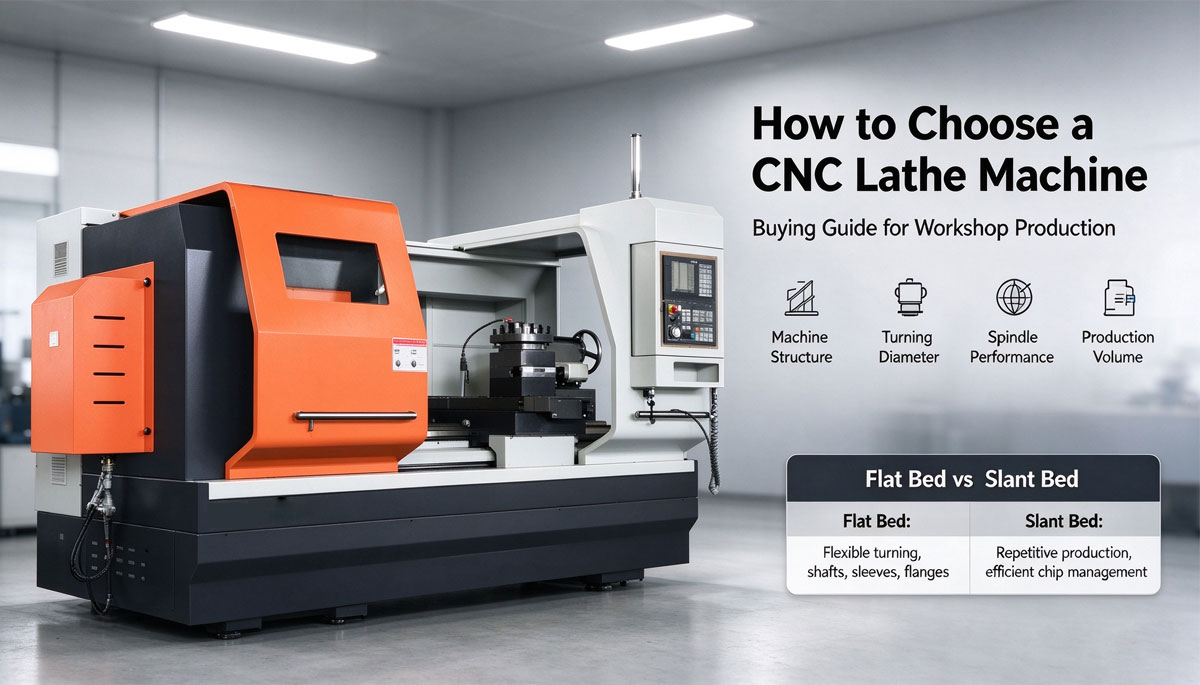
For manufacturers, distributors and equipment buyers, key considerations include machine structure, turning diameter, machining length, spindle performance and production volume.
This guide explains the main types of CNC lathe machines, essential specifications and practical buying considerations to help you make an informed decision.
What Is a CNC Lathe Machine?
A CNC lathe machine is a computer-controlled machine tool that rotates a workpiece while cutting tools remove material to produce the required shape.
A CNC lathe machine for metal can perform operations such as external turning, facing, boring, grooving and threading, depending on its configuration.
Compared with conventional manual lathes, CNC machines offer programmable movements and repeatable machining processes, making them suitable for both small-batch manufacturing and repetitive production.
Main Types of CNC Lathe Machines
- Flat Bed CNC Lathe
A flat bed CNC lathe is commonly considered for general turning applications, flexible setups and workpieces requiring specific diameter or length capacities.
It may suit workshops producing shafts, sleeves, flanges and other mechanical components. Actual capability depends on swing over bed, turning length, spindle bore and machine rigidity.
Best for: Flexible machining requirements and applications where workpiece dimensions and setup versatility are key considerations.
- Slant Bed CNC Lathe
A slant bed CNC lathe features an inclined bed structure that can help improve chip evacuation and support compact machine layouts.
Depending on the configuration, it may be suitable for repetitive production, automated loading and manufacturing processes requiring efficient chip management.
Best for: Production environments prioritizing repeatability, cycle efficiency and potential automation.
Flat Bed vs. Slant Bed CNC Lathe
| Factor | Flat Bed CNC Lathe | Slant Bed CNC Lathe |
| Main consideration | Flexible turning tasks | Repetitive production |
| Workpiece capacity | Depends on machine specifications | Depends on machine specifications |
| Chip management | Depends on machine design | Inclined structure can assist chip evacuation |
| Automation | Available on suitable models | Often considered for automated production |
Neither design is universally better. The right choice depends on workpiece dimensions, machining operations, production volume and budget.
Key CNC Lathe Machine Specifications
Before purchasing a CNC lathe machine, compare the following specifications with your actual production requirements.
- 1. Maximum Turning Diameter and Length
Check the maximum turning diameter, swing over bed and usable turning length. These specifications determine whether the machine can accommodate your largest workpieces.
For long shafts, consider whether a tailstock or steady rest is required.
- 2. Spindle Speed, Power and Torque
Spindle performance affects cutting capability across different materials and workpiece sizes. Higher speed does not automatically mean higher productivity; sufficient torque and rigidity are also important for demanding cutting operations.
- 3. CNC Control and Axis Configuration
Confirm the control system, available axes, programming functions and compatibility with your existing production workflow.
If your parts require additional milling operations, check whether the selected configuration supports live tooling or whether a separate machining process is needed.
- 4. Accuracy and Repeatability
For precision components, review the manufacturer’s positioning accuracy and repeatability specifications, applicable test conditions and inspection procedures.
For critical applications, provide sample drawings and request a machining evaluation before ordering.
- 5. Tooling and Accessories
The chuck, tool turret, tool holders, tailstock and other accessories affect the machine’s actual capabilities.
When comparing quotations, confirm the complete configuration rather than evaluating the base machine alone.
Common Applications of CNC Lathe Machines
CNC lathe machines are widely used to manufacture rotational components across different industries.
Typical applications include:
Automotive: Shafts, pins, bushings and selected drivetrain components.
Industrial machinery: Rollers, sleeves, couplings and mechanical fittings.
Hydraulic equipment: Cylindrical components, connectors and precision sleeves.
General manufacturing: Flanges, threaded parts and custom components.
Material, dimensions, tolerances and production quantity should all be considered when selecting a machine.
How to Choose the Right CNC Lathe Machine
Follow these five steps before making a purchasing decision:
Define your workpieces. Prepare drawings or samples showing material, diameter, length and critical tolerances.
Estimate production volume. Determine whether you need flexible small-batch production or repetitive high-volume machining.
Select the machine structure. Compare flat bed and slant bed designs against your actual machining requirements.
Evaluate operating requirements. Consider tooling, installation, training, maintenance and spare parts.
Confirm machine capability. Request detailed specifications and clarify the included accessories, delivery scope and technical support.
Providing accurate workpiece information helps the manufacturer recommend a more suitable machine configuration and reduces the risk of purchasing equipment that does not meet your needs.
Why Choose a CNC Lathe Machine Manufacturer?
Working directly with a machine tool manufacturer can help buyers clarify technical specifications, equipment configurations and delivery requirements.
For distributors and end users, it is important to confirm machine inspection, packaging, documentation, warranty conditions and after-sales support before placing an order.
GOLDCNC supplies machine tools and supports customers in evaluating equipment configurations based on their machining requirements.
Frequently Asked Questions
- What is the difference between a CNC lathe and a CNC turning machine?
The terms are often used interchangeably. A CNC turning center may offer additional functions, such as live tooling or more advanced axis configurations.
- Can a CNC lathe machine cut steel?
Yes. CNC lathes can machine many steel grades when the machine, tooling, workholding and cutting parameters are correctly selected.
- Which CNC lathe is better for production?
The best choice depends on workpiece geometry, production volume, accuracy requirements and automation needs. Compare actual specifications rather than relying on machine structure alone.
- How do I choose the right CNC lathe machine?
Provide the manufacturer with your workpiece drawings, material, dimensions, tolerances and expected production volume. These details help determine the appropriate machine capacity and configuration.
Find the Right CNC Lathe Machine for Your Application
Choosing the right CNC lathe machine starts with understanding your parts, production goals and technical requirements.
GOLDCNC can help you evaluate suitable machine configurations for your workshop or distribution business.
Contact GOLDCNC to discuss your machining requirements and equipment selection needs.
