
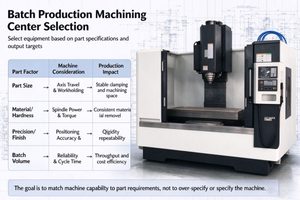
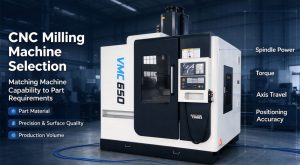
Selecting a Vertical Machining Center should start with the parts you intend to manufacture rather than the machine model itself.
Different CNC parts require different combinations of working envelope, spindle performance, workholding, tool capacity, machining operations, and production flexibility.
A CNC vertical machining center is particularly suitable for components requiring multiple milling, drilling, boring, reaming, and tapping operations from a common setup. GOLDCNC’s VMC range is designed around this type of multi-process machining workflow.
Start With Part Geometry
Before selecting a VMC, examine the actual part drawing.
Ask:
- How large is the component?
- How tall is it?
- How many holes are required?
- Are there pockets or slots?
- Are there multiple mounting surfaces?
- Are there curved or contoured surfaces?
- How many operations are required?
- Can the component be machined from one main setup?
These questions are more useful than selecting a machine based only on spindle speed.
Sandvik’s machining selection guidance similarly begins with component shape, workpiece material, feature type, tolerance, surface finish, and batch size.
Why One Setup Matters
One of the major advantages of a Vertical Machining Center is process integration.
A suitable part may allow several operations to be completed from the same workholding setup:
Facing → Side Milling → Pocketing → Drilling → Boring → Tapping → Finishing
Reducing unnecessary repositioning can simplify production and reduce the opportunity for accumulated setup errors.
This becomes particularly useful for mounting plates, housings, fixtures, and components with multiple hole patterns.
Choose the Machine Size From the Real Workpiece
A larger machine is not automatically the correct machine.
The working envelope should accommodate:
- Workpiece dimensions
- Fixture dimensions
- Tool access
- Clamping arrangement
- Required travel
- Clearance around the component
The machine must provide enough space not only for the part itself but also for the tooling and workholding system.
For example, a large fixture can significantly reduce the usable table area even when the workpiece appears relatively small.
Vertical Machining Center for Mechanical Components
Mechanical equipment manufacturers often machine:
- Gear housings
- Bearing housings
- Mounting plates
- Machine bases
- Brackets
- Connecting components
- Hydraulic blocks
These parts frequently contain multiple holes, pockets, flat surfaces, and mounting features.
A VMC can consolidate several operations and reduce the number of machines involved in the process.
VMC Applications in Mold Manufacturing
Mold components place different demands on a machining center.
The machine may need to handle:
- Mold bases
- Cavities
- Inserts
- Core components
- Electrode-related components
- Complex pockets
- Contoured surfaces
When mold geometry becomes more complex, machine configuration, tooling, CAM strategy, and axis capability become increasingly important.
For multi-sided or complex components, rotary or additional-axis solutions can reduce the number of setups. Haas, for example, emphasizes workpiece size, machine configuration, tooling, workholding, and CAM planning when selecting multi-axis equipment.
VMC Applications for Automotive and Construction Machinery
Automotive and construction machinery components often combine:
- Large mounting surfaces
- Multiple holes
- Slots
- Pockets
- Bearing locations
- Structural features
Examples include brackets, housings, mounting plates, hydraulic components, and structural mechanical parts.
The machine should therefore be selected according to the largest and most demanding part family rather than the smallest component.
