

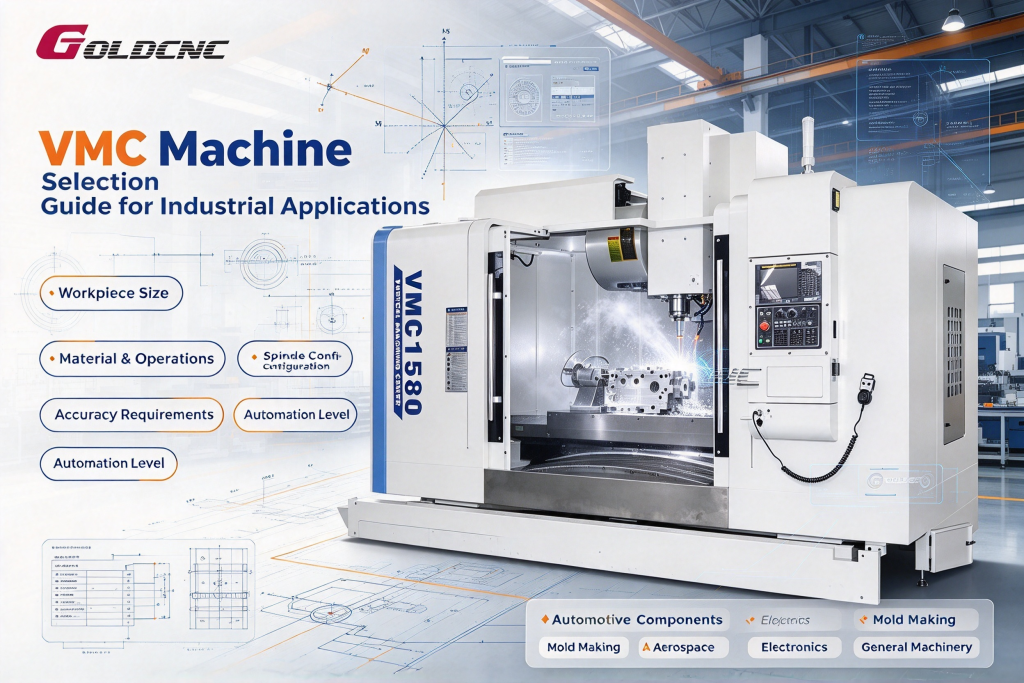
Choosing the right VMC machine is an important decision for manufacturers seeking consistent machining results, suitable production capacity, and a configuration that meets their workpiece requirements. A vertical machining center (VMC) can perform milling, drilling, boring, tapping, and other machining operations, depending on its configuration and tooling.
The appropriate machine depends on workpiece dimensions, material, machining operations, dimensional tolerances, spindle requirements, and production volume. Selecting a machine based on model name or table size alone may lead to insufficient working clearance, unsuitable cutting performance, or unnecessary investment in equipment capacity.
GOLDCNC manufactures CNC machine tools, including vertical machining centers for a range of industrial applications. This guide explains how to evaluate VMC specifications, compare machine configurations, assess common manufacturing requirements, and prepare for a more informed purchasing decision.
1. How to Choose the Right VMC Machine
Before purchasing a CNC VMC machine, evaluate the complete machining process rather than focusing on a single specification.
Workpiece Dimensions and Axis Travel
Check the X-, Y-, and Z-axis travel, worktable dimensions, spindle-to-table distance, and available space for fixtures and tools.
Axis travel determines the available movement of the machine axes, but it does not directly represent the maximum size of every workpiece that can be machined. The fixture, tool length, workpiece geometry, and required spindle clearance also affect the usable machining envelope.
For example, a workshop machining mounting plates may prioritize X- and Y-axis travel, while a workshop processing taller housings should pay closer attention to Z-axis travel and spindle-to-table clearance.
Before requesting a quotation, prepare the maximum workpiece dimensions and the proposed clamping arrangement.
Material and Machining Operations
The material and machining process influence spindle requirements, cutting tools, feed rates, and machine configuration.
Common applications include:
- Milling flat surfaces, steps, and pockets.
- Drilling and tapping mounting holes.
- Boring holes where the required process and tooling permit.
- Machining mold bases, inserts, and other tooling components.
- Processing mechanical housings, brackets, and mounting plates.
Steel, aluminum, cast iron, and other materials can require different cutting parameters and tooling strategies. A suitable configuration should reflect the actual material grade, stock condition, material removal requirements, and finish specifications.
Spindle Speed, Power, and Torque
Spindle selection should be based on the cutting tools, material, and machining operations.
Spindle speed is relevant to cutting conditions and tool diameter. Power and torque influence the machine’s ability to perform different cutting operations within the specified operating range.
For example, aluminum components may require a different spindle-speed range from steel components involving heavier cutting operations. However, spindle speed alone does not determine machining performance. Tooling, tool engagement, machine rigidity, and cutting parameters must also be considered.
When comparing machines, confirm the spindle taper, speed range, power rating, torque characteristics where available, and compatibility with the intended tooling.
Machining Accuracy and Repeatability
If the parts require close dimensional tolerances, review the manufacturer’s positioning accuracy, repeatability, applicable measurement standard, and inspection documentation.
Machine specifications should be considered alongside the complete production process. Workholding, tool condition, thermal changes, cutting forces, machine setup, and measurement methods can all affect the final part.
Ask the supplier to clarify the applicable accuracy specifications and the conditions under which they are measured. If your parts have critical dimensions, provide the drawings and tolerance requirements before selecting the machine.
Tool Magazine and Automatic Tool Changing
A tool magazine and automatic tool changer (ATC) can reduce manual tool-changing tasks during compatible machining sequences.
The required magazine capacity depends on the number of tools used in a typical job, the frequency of tool changes, and the variety of parts being produced.
For mixed production, consider whether the available tool positions can accommodate the required cutters, drills, taps, and other tools. Also verify tool-holder compatibility, maximum tool dimensions, and the applicable tool-change specifications.
Three-Axis, Four-Axis, and Five-Axis Configurations
A standard three-axis VMC moves along the X, Y, and Z axes. Additional rotary axes can provide access to more workpiece surfaces or support more complex machining operations.
A fourth-axis rotary table may be useful for parts requiring indexed machining around multiple sides. Five-axis configurations may be appropriate for more complex geometries, depending on the machine design and process requirements.
Additional axes are not automatically necessary for every application. Evaluate part geometry, required access, setup time, programming capability, and the expected production benefits before choosing an advanced configuration.
2. GOLDCNC VMC Models and Working Ranges
GOLDCNC offers vertical machining centers in different working ranges and configurations. Relevant models include VMC650, VMC850, VMC1160, VMC1270, and VMC1370, alongside the DV series and other machining-center options.
The following examples use published product specifications as an initial reference. Confirm the current model designation and configuration with GOLDCNC before ordering.
VMC650: Compact Machining Requirements
The VMC650 CNC vertical machining center has published X-, Y-, and Z-axis travels of 650 × 400 × 500 mm and a worktable measuring 800 × 400 mm.
It may be considered for smaller mechanical components, brackets, mounting plates, and other parts that fit within the available machining envelope.
Before selecting this model, check the actual workpiece dimensions, fixture footprint, required tool access, and worktable load.
VMC850: General-Purpose Machining
The VMC850 CNC vertical machining center has published axis travels of 800 × 500 × 500 mm and a worktable measuring 1,000 × 500 mm.
This working range may suit a variety of general machining tasks, including compatible housings, plates, mechanical components, and mold-related parts.
The final selection should account for workpiece size, material, cutting requirements, spindle configuration, and production volume rather than model designation alone.
VMC1160: Larger Workpiece Requirements
The VMC1160 CNC vertical machining center has published axis travels of 1,100 × 600 × 600 mm and a worktable measuring 1,200 × 600 mm.
It may be worth evaluating when a workshop needs additional X-axis travel for longer components or larger machining envelopes.
Confirm the maximum workpiece dimensions, fixture clearance, table load, and required spindle-to-table distance before finalizing the selection.
VMC1270 and VMC1370: Extended Working Ranges
For applications involving larger plates, housings, and tooling components, compare the VMC1270 CNC vertical machining center and VMC1370 CNC vertical machining center.
Published specifications list the VMC1270 with X-, Y-, and Z-axis travels of 1,200 × 700 × 700 mm. The VMC1370 is listed with travels of 1,300 × 800 × 700 mm.
These dimensions provide a useful starting point for comparing working ranges. However, workpiece geometry, fixture size, loading method, and required cutting conditions must also be evaluated.
Comparing VMC Models Before Purchase
When comparing models, prepare a specification checklist covering:
- X-, Y-, and Z-axis travel.
- Worktable dimensions and maximum permitted load.
- Spindle speed, power, torque, and taper.
- Tool magazine capacity and tool-change requirements.
- Positioning accuracy and repeatability.
- CNC controller and available functions.
- Optional rotary axes, probing, and chip removal equipment.
- Electrical requirements, installation space, and operating conditions.
Explore the GOLDCNC vertical machining center range to compare available models and request the specifications relevant to your application.
3. Industrial Applications and Representative Machining Scenarios
A suitable VMC configuration depends on the parts being produced and the operations required. The following examples illustrate typical manufacturing scenarios; they are not claims of verified GOLDCNC customer projects.
Automotive Parts Manufacturing
Typical components: Mounting brackets, aluminum housings, mounting plates, and mechanical support components.
Representative machining scenario: A manufacturer needs to mill reference surfaces, drill mounting holes, and machine threaded holes on an aluminum housing.
Selection considerations:
- Workpiece dimensions and fixture arrangement.
- Hole positions and dimensional tolerances.
- Required spindle speed and cutting tools.
- Production batch size and cycle-time requirements.
- Tool magazine capacity and the potential use of a rotary axis.
Where part geometry permits, combining compatible operations within fewer setups may reduce repeated repositioning and setup-related variation.
Explore the VMC machines for automotive parts machining to connect the machine selection process with automotive component requirements.
Mold and Die Manufacturing
Typical components: Mold bases, cavity blocks, inserts, and tooling plates.
Representative machining scenario: A mold shop needs to machine pockets, mounting holes, and reference surfaces on a steel mold component.
Selection considerations:
- Workpiece size, weight, and clamping stability.
- Machine rigidity and spindle capability.
- Cutter length, tool access, and chip evacuation.
- Required surface finish and dimensional tolerances.
- Whether the geometry can be completed on a three-axis machine or needs additional axes.
For mold work, selecting the appropriate tooling strategy and machining configuration is essential. The required surface finish and machining time should be evaluated against the actual material and geometry.
Explore the VMC machines for mold and die machining for related applications.
Aerospace Component Machining
Typical components: Suitable aluminum brackets, structural components, and precision mounting parts.
Representative machining scenario: A manufacturer needs to mill pockets, reference faces, and drilled features on an aluminum alloy component.
Selection considerations:
- Material grade and machining allowances.
- Workpiece geometry and fixture rigidity.
- Dimensional tolerances and inspection requirements.
- Tool access and the required machining sequence.
- Applicable customer and industry documentation.
A machine should only be selected after confirming that its specifications and proposed configuration are appropriate for the component’s technical requirements. Aerospace-related applications may also involve specific process qualification and traceability requirements that must be assessed separately.
Electronics and Industrial Equipment
Typical components: Equipment enclosures, mounting plates, machine frames, and mechanical support parts.
Representative machining scenario: A supplier needs to mill reference surfaces and mounting holes on an aluminum equipment plate.
Selection considerations:
- Worktable dimensions and part support.
- Required flatness and dimensional tolerances.
- Fixture design and workpiece deformation.
- Tool selection and surface-finish requirements.
- Repeatability across production batches.
For thin or large plates, the workholding strategy and cutting sequence can influence the final result. Machine specifications should be evaluated alongside the intended process.
General Machinery, Automation, and Robotics
Typical components: Gearbox housings, machine bases, robot mounting plates, and automation equipment components.
Representative machining scenario: A manufacturer needs to mill locating surfaces and drill multiple mounting holes on a mechanical housing.
Selection considerations:
- Workpiece envelope and table load.
- Clamping stability and tool accessibility.
- Number of operations and setup sequence.
- Required tool magazine capacity.
- Expected production volume and changeover frequency.
A suitable VMC can support several compatible machining operations in one setup. The actual benefit depends on part geometry, tooling, programming, and the selected configuration.
4. Common VMC Purchasing Concerns and How to Address Them
Insufficient Machining Capacity
A machine may have adequate table dimensions but insufficient axis travel, spindle clearance, or room for fixtures and tools.
Recommended approach: Provide the largest workpiece dimensions and a drawing of the proposed setup. Check axis travel, spindle-to-table distance, fixture clearance, and table load before placing an order.
Inconsistent Machining Accuracy
Machining variation may be associated with machine condition, workholding, tooling, thermal changes, cutting forces, or measurement methods.
Recommended approach: Define the critical dimensions and tolerances, review the relevant machine accuracy specifications, and discuss the proposed inspection method with the supplier.
Longer-Than-Expected Machining Cycles
Cycle time depends on the part geometry, material, tool paths, cutting parameters, tool changes, and workpiece handling.
Recommended approach: Share the part drawing, material, required output, and main machining operations. Evaluate the complete process rather than assuming that higher spindle speed alone will shorten the cycle.
Unsuitable Spindle or Tool Magazine Configuration
A spindle or tool magazine that does not match the planned tooling can limit the available machining process or require additional changes.
Recommended approach: Prepare a list of the required tools, holders, tool dimensions, and typical machining operations. Confirm spindle compatibility, magazine capacity, and tool-change requirements.
Unclear Machine Configuration in the Quotation
A model name alone does not fully define the supplied machine. The CNC controller, spindle, tool magazine, accessories, and optional equipment may vary by configuration.
Recommended approach: Request a written specification sheet that identifies the agreed machine model, standard equipment, optional equipment, technical parameters, electrical requirements, and included services.
5. How to Evaluate a China VMC Machine Manufacturer
When searching for a China VMC machine manufacturer, buyers should evaluate technical suitability, documentation, configuration transparency, and the supplier’s ability to support the purchasing process.
A lower initial quotation does not necessarily represent the best overall fit. Differences in spindle configuration, controller, tool magazine, accessories, inspection requirements, and delivery scope can affect the total purchasing decision.
Before placing an order, consider the following points.
Product Range and Technical Documentation
Review the manufacturer’s relevant product pages, machine specifications, standard configuration, and available options.
Ask for clarification whenever a model name or specification does not fully describe the supplied configuration.
Quality Inspection and Compliance Documentation
Request the relevant quality inspection records and certificates applicable to the machine being purchased. Confirm that any claimed certification applies to the specific model and intended market.
Where a particular inspection standard or tolerance is important, clarify the measurement method and acceptance criteria before ordering.
Configuration and Communication
Provide drawings, material specifications, production requirements, and critical tolerances so the supplier can evaluate the proposed machine.
Confirm the agreed configuration in writing and ensure that the quotation and purchase contract use consistent technical specifications.
Installation and After-Sales Arrangements
Before purchase, clarify the scope of installation guidance, operator training, documentation, warranty terms, spare parts, and technical support.
The availability and scope of these services should be confirmed for the specific order rather than assumed from general product information.
GOLDCNC manufactures CNC machine tools, including vertical machining centers. Buyers can contact the team to review available models, discuss application requirements, and confirm the technical specifications relevant to their production needs.
Explore the GOLDCNC CNC machine tool manufacturer page for company information and the 【内链:GOLDCNC contact page】 to discuss a machine configuration.
6. What Information Should You Prepare Before Requesting a VMC Quotation?
Providing clear technical information can help reduce unnecessary specification changes during the purchasing process.
Prepare the following details where available:
- Workpiece drawings: Include overall dimensions, critical features, and relevant tolerances.
- Material specifications: Identify the material grade and stock condition.
- Machining operations: List milling, drilling, tapping, boring, and other required processes.
- Workpiece dimensions and weight: Include the largest part and proposed fixture arrangement.
- Production requirements: Specify batch size, expected output, and operating schedule.
- Accuracy and finish requirements: Identify critical dimensions and required surface conditions.
- Tooling requirements: Provide information about tool holders, cutter dimensions, and the required tool range.
- Automation requirements: Explain whether a rotary table, probing system, chip conveyor, or other options are needed.
- Installation conditions: Confirm local voltage, frequency, phase, available floor space, and other relevant site requirements.
With this information, GOLDCNC can review the available options and clarify which specifications need to be confirmed before a quotation is finalized.
Request a VMC Machine Quotation
Looking for a VMC machine for automotive components, mold making, general machinery, or other industrial applications?
Share your workpiece drawings, material, required machining operations, critical tolerances, and expected production volume with GOLDCNC.
The team can help you compare available vertical machining center models, review relevant configuration options, and confirm the technical specifications for your application.
Contact GOLDCNC for a VMC machine quotation to discuss your manufacturing requirements.
