

Choosing a band saw machine is not simply a matter of selecting the largest cutting capacity or the highest blade speed. The correct machine depends on the size and shape of the raw material, required cutting length, production volume, material type, and the machining process that follows sawing.
For fabrication shops, steel service centers, machinery manufacturers, and CNC machining plants, sawing is often the first step in the production process. A suitable metal band saw machine can prepare blanks efficiently while reducing unnecessary material waste and manual handling before turning, milling, or machining center operations.
What Should Be Considered When Selecting a Band Saw Machine?
A practical selection should begin with the workpiece rather than the machine model.
The main factors include:
- Maximum workpiece diameter or rectangular section
- Material type and hardness
- Required cutting angle
- Individual cutting length
- Number of pieces per batch
- Manual or automatic material feeding requirements
- Required production consistency
- Whether the cut blanks will be processed by CNC equipment afterward
This approach prevents a common purchasing mistake: selecting a machine based only on cutting capacity while ignoring the actual production workflow.
1. Match the Band Saw Machine to the Workpiece Size
Cutting capacity is one of the first specifications to check.
For round stock, the maximum diameter is usually used to define machine capacity. For square or rectangular material, both width and height must be considered.
For example, a workshop cutting:
- Round steel bars
- Square steel sections
- Rectangular plates
- Structural profiles
- Large pipes
- Forged or cast blanks
may require completely different machine configurations even when the nominal cutting diameter appears similar.
A heavy-duty band saw machine is more appropriate when the workpiece has a large cross-section, high weight, or requires stable cutting under demanding conditions.
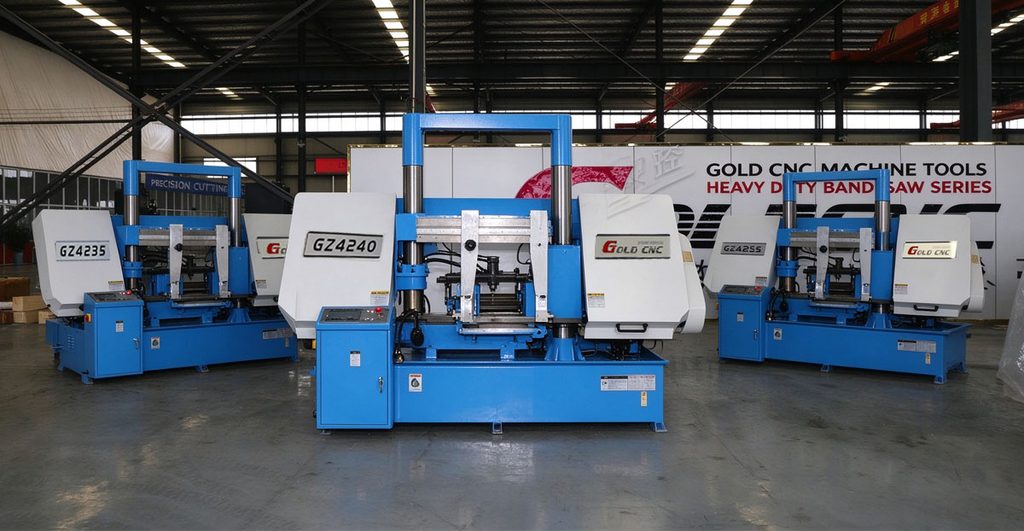
For large structural sections and heavy blanks, the machine must provide sufficient structural rigidity and workpiece support. GOLDCNC’s heavy-duty band saw range includes models designed for large sections and heavy workpieces, such as the GB42100, which provides a 1000 mm cutting capacity.
2. Horizontal Band Saw Machines for General Industrial Cutting
A horizontal band saw machine is commonly used for cutting bars, tubes, profiles, and general stock material into predetermined lengths.
It is particularly useful when the workshop needs to prepare raw material before:
- CNC turning
- CNC milling
- Vertical machining
- Horizontal machining
- Welding and fabrication
- Component assembly
For example, a machining workshop may purchase round steel bars in long lengths. Instead of loading the complete bar onto a CNC lathe, the operator can first cut it into manageable blanks.
This separates the material preparation process from precision machining and can make the overall workflow easier to organize.
3. Semi-Automatic vs. Automatic Band Saw Machines
The production quantity should influence the level of automation.
Semi-Automatic Band Saw Machine
A semi-automatic band saw is suitable when operators need flexibility to process different sizes and materials.
Typical applications include:
- Job shops
- Maintenance departments
- Small-batch production
- Mixed-size workpieces
- Custom component manufacturing
The operator can adjust the material and cutting requirements according to different production orders.
Automatic Band Saw Machine
An automatic band saw machine becomes more valuable when the same material or similar blanks must be produced repeatedly.
Automatic functions can reduce repetitive manual operations such as material feeding and cutting-cycle handling.
This is particularly useful for:
- Repetitive component production
- Long production runs
- Standardized blanks
- Steel service centers
- Automotive component suppliers
- Machinery component manufacturers
4. When Should You Choose a Heavy-Duty Band Saw Machine?
Heavy-duty sawing becomes necessary when the raw material itself creates the main cutting challenge.
Typical workpieces include:
- Large steel bars
- Heavy pipes
- Structural profiles
- Large forgings
- Cast components
- Construction machinery blanks
- Oversized mechanical components
In these applications, machine rigidity, workpiece support, hydraulic clamping, blade stability, and cutting capacity become more important than simply increasing cutting speed.
For large blanks, stable material positioning is also important because vibration during sawing can influence blade life and cut consistency.
For more information, explore GOLDCNC’s Metal Band Saw Machine range, including horizontal, automatic, heavy-duty, miter, and double-column configurations.
